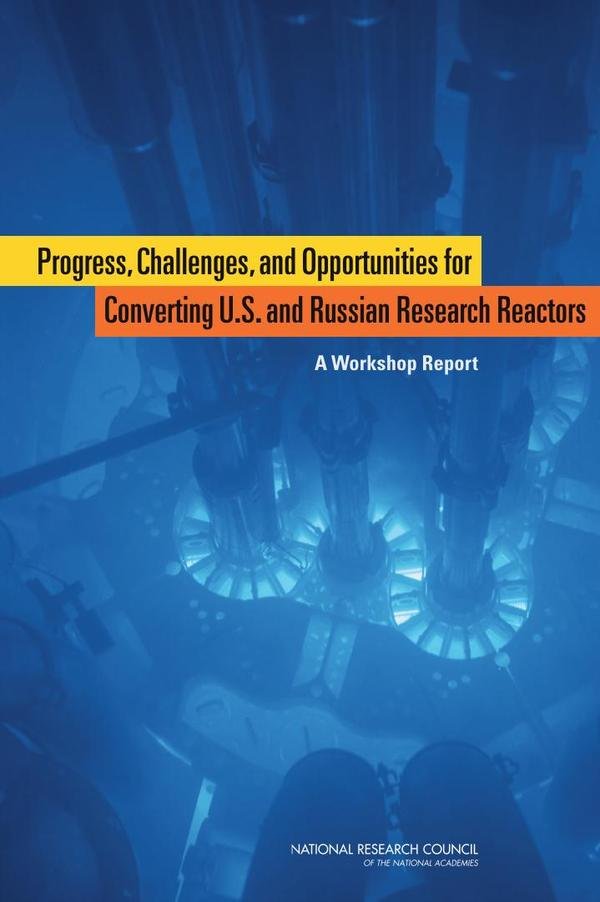
Progress, Challenges, and Opportunities for Converting U.S. and Russian Research Reactors

$158,195

Tu compra es fácil y rápida

Múltiples métodos de pago

Envío estimado de 5 a 12 días hábiles

Compra segura y garantizada

526 ¡Personas viendo este producto ahora!
Descripción

Highly enriched uranium (HEU) is used for two major civilian purposes: as fuel for research reactors and as targets for medical isotope production. This material can be dangerous in the wrong hands. Stolen or diverted HEU can be used-in conjunction with some knowledge of physics-to build nuclear explosive devices. Thus, the continued civilian use of HEU is of concern particularly because this material may not be uniformly well-protected. To address these concerns, the National Research Council (NRC) of the U.S. National Academies and the Russian Academy of Sciences (RAS) held a joint symposium on June 8-10, 2011.Progress, Challenges, and Opportunities for Converting U.S. and Russian Research Reactors summarizes the proceedings of this joint symposium. This report addresses: (1) recent progress on conversion of research reactors, with a focus on U.S.- and R.F.-origin reactors; (2) lessons learned for overcoming conversion challenges, increasing the effectiveness of research reactor use, and enabling new reactor missions; (3) future research reactor conversion plans, challenges, and opportunities; and (4) actions that could be taken by U.S. and Russian organizations to promote conversion. The agenda for the symposium is provided in Appendix A, biographical sketches of the committee members are provided in Appendix B, and the report concludes with the statement of task in Appendix C.

Información adicional
pa_autor

AA. VV.

pa_editorial

National Academies Press

pa_idioma

Inglés

Valoraciones (0)

Valoraciones

No hay valoraciones aún.

Sé el primero en valorar “Progress, Challenges, and Opportunities for Converting U.S. and Russian Research Reactors”

Tu dirección de correo electrónico no será publicada. Los campos obligatorios están marcados con *

Tiempos de entrega

INFORMACIÓN SOBRE TIEMPOS DE ENTREGA

Tiempos de entrega

Los tiempos de entrega pueden variar según:

  • País o ciudad de destino

  • Disponibilidad del producto en el sistema de Bibliomanager

  • Capacidad logística del transportista asignado

En general, los envíos suelen tardar entre 5 y 12 días hábiles, dependiendo de la ubicación del cliente.
Los tiempos son estimados y pueden variar por factores externos (clima, eventos locales, fechas especiales, etc.).